5 Ways to improve visitor experience at your venue
Too often, leadership teams spend their budgets on the “Big Thing”. However, the visitor experience is actually built in the gaps between those highlights. It is the silent engine of your reputation. If a guest spends their first twenty minutes frustrated by parking or their last twenty minutes stuck in a gift shop bottleneck, the quality of your exhibits becomes irrelevant. They will remember the friction, not the features.
In a world where every guest is a potential reviewer with a smartphone, your operational flaws are on public display. Visitors aren’t just looking for content. They are looking for a seamless integration of physical space and digital ease.
Here are five practical ways to smooth out that journey and ensure your guests leave as advocates rather than critics.
1. Master “Intuitive” Wayfinding
Wayfinding is the first test of your venue’s hospitality. If a visitor has to stop and squint at a map every five minutes, your design has failed them. Arrival anxiety is a real phenomenon where guests feel a spike in cortisol because they do not know where to go or what the rules are.
The best visitor experience feels like the building is guiding you without saying a word. It creates a psychological safety net that allows the guest to focus on your content rather than their own confusion.
for example
The Guggenheim Museum Bilbao in Spain. Instead of relying solely on a forest of arrows, the architecture itself serves as a compass.
The central atrium acts as a “home base” that visitors naturally return to, providing a constant sense of orientation. High-contrast floor markers and lighting cues guide guests through the galleries without breaking the “spell” of the art.
The lesson?
Use light, color, and architectural landmarks to pull people toward their next destination rather than forcing them to decipher complex signage.
2. Kill the “Repetitive Questions Loop”
Your front-line staff are the heartbeat of your organization, but they are often treated like human search engines. If your reception team spends the majority of their shift pointing toward the restrooms or explaining ticket tiers, you are wasting their talent and your payroll. This cycle of repetitive questions leads to staff burnout and long, unnecessary queues that kill the momentum of a visit before it even starts.
When staff are forced into a loop of mundane answers, they lose the energy required for genuine, high-value hospitality.
for example
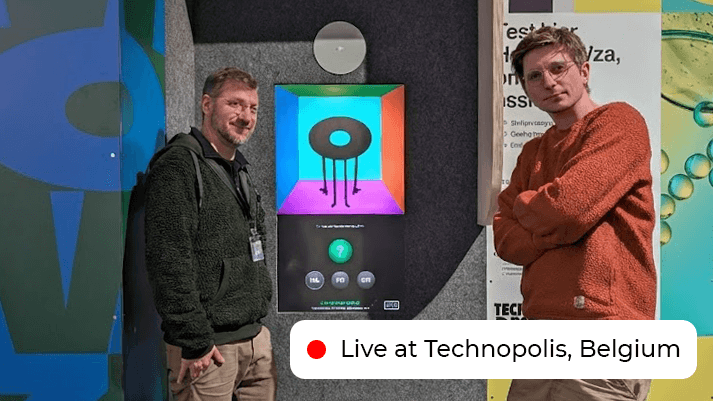
Technopolis offloaded the “FAQ fatigue” to smart technology with LMLM’s Talking Points.
By placing interactive AI stations at key decision points, visitors can simply ask a question in their native language and get an immediate, conversational response.
The lesson?
Free up your human staff to handle meaningful interactions and complex guest needs. The tech can handle the 1,000th person asking where the café is, while your team focuses on creating memorable moments.
looking to improve visitor experience?
If these projects resonate with you, LMLM could help!
3. Sensory downtime as ROI strategy
We have to stop treating “quiet time” as a luxury. In the race to be interactive and “gamified” many venues have created environments that are sensory minefields. For families with children, neurodivergent guests, or even just adults who want to process what they’ve seen, constant stimulation is a barrier to entry.
If you do not provide a place for the brain to decompress, your visitors will experience “cognitive overload” and leave. This is not just about kindness. It is about retention. An overwhelmed visitor spends less time and less money in your facility.
for example
The Museum of Fine Arts (MSK) in Ghent has leaned heavily into the concept of “Slow Art” and dedicated quiet spaces. As noted in their vision on accessibility and well-being, they offer specific “quiet moments” and spaces designed for reflection.
Romaine, CC BY-SA 4.0, via Wikimedia Commons
“A visit to the museum should be a moment of rest, not an obstacle course of impressions.”
The lesson?
Integrate “recharge zones” with comfortable seating and lower acoustic levels. This is vital for science centers and theme parks where the noise floor is naturally high.
4. Solve the multilingual barrier
The language barrier presents a logistical puzzle that many venues solve poorly. Traditional “tombstone” labels with five different translations look cluttered and are rarely read by anyone. When a guest cannot understand the story you are telling, they lose interest.
Accessibility is not just about ramps. It is about intellectual access. If your content is locked behind a language the visitor does not speak fluently, you have effectively closed your doors to them.
for example
The Parlamentarium in Brussels manages visitors from across the EU by using personal multimedia guides that automatically sync to the visitor’s language.
The lesson?
Do not crowd your physical space with text. Use digital-first, conversational interfaces that adapt to the visitor. If a guest from Italy can ask a question in Italian and get a helpful answer at a Belgian nature park, you have just won their loyalty for life.
5. The perfect “ending note”
The “Peak-End Rule” is a psychological principle that suggests people judge an experience based on how they felt at its peak and at its conclusion. Surprisingly, the “End” is often where venues drop the ball. Most organizations put 90% of their energy into the main attraction and almost zero into the exit path.
If the last thing a guest does is struggle to find their car or wait in a stagnant line to pay for a locker, that frustration will be the dominant memory of their entire day.
for example
Efteling in the Netherlands. They treat the walk back to the parking lot as part of the story. The music, the lighting, and even the “Holle Bolle Gijs” trash cans maintain the theme until the very last second.
The Lesson?
Audit your exit. Is the coat-check retrieval fast? Is the path to the exit clear? Can they pay for parking without a 15-minute wait? If the last thing they do is wait in a line, that is the story they will tell their friends.
looking to improve visitor experience?
If these projects resonate with you, LMLM could help!