Talking water of Bruges gives the river a voice
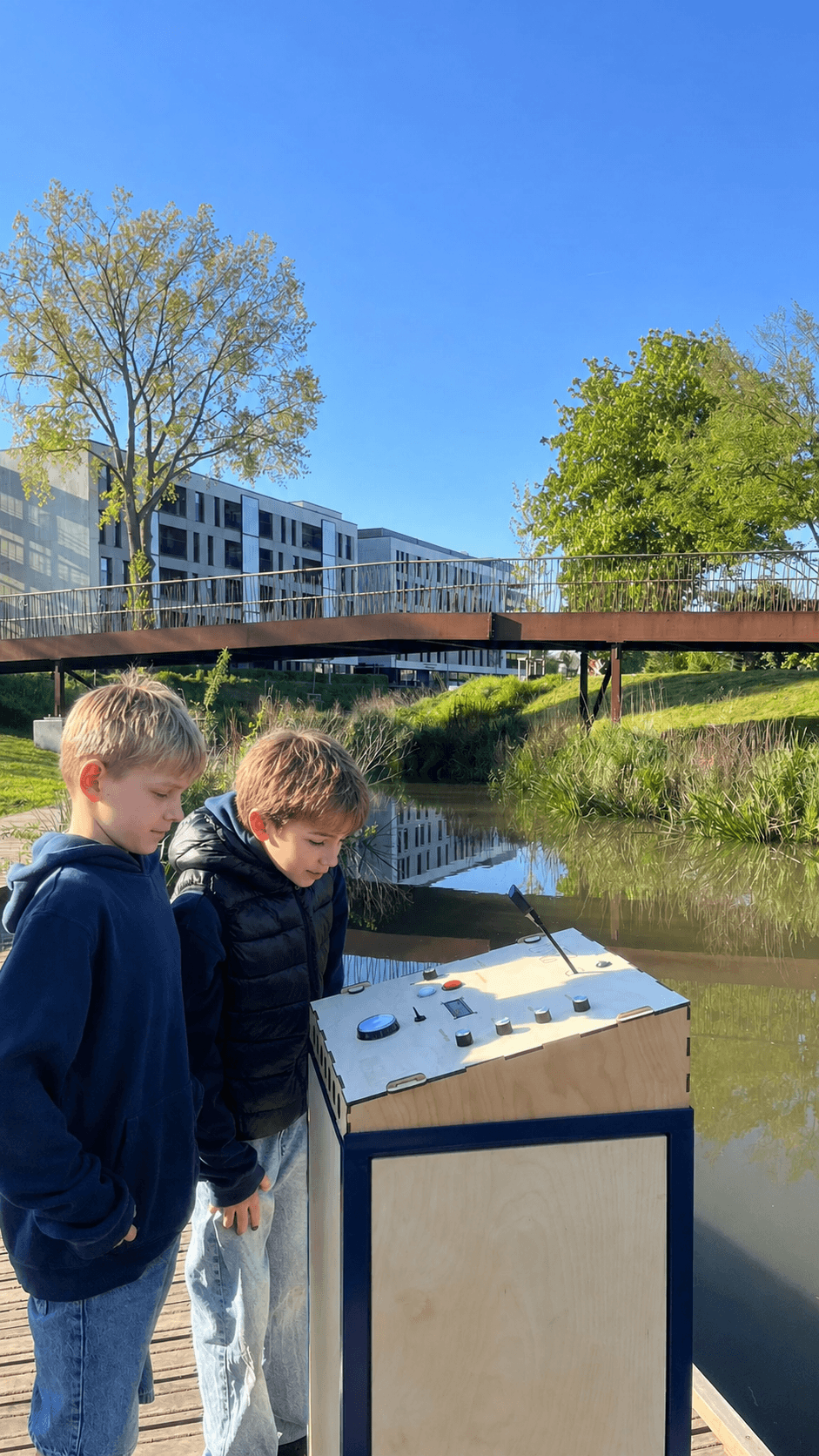
At the water’s edge in Bruges stands a wooden console with many tantelizing buttons, a screen and a speaker. Ask it anything and the water answers for itself, in a voice tuned to live sensor readings.
Interested in something like this for your venue? Contact us.
Letting the water speak for itself
The Waterpraatpaal invites residents, visitors and schools to strike up a conversation with the water of Bruges.
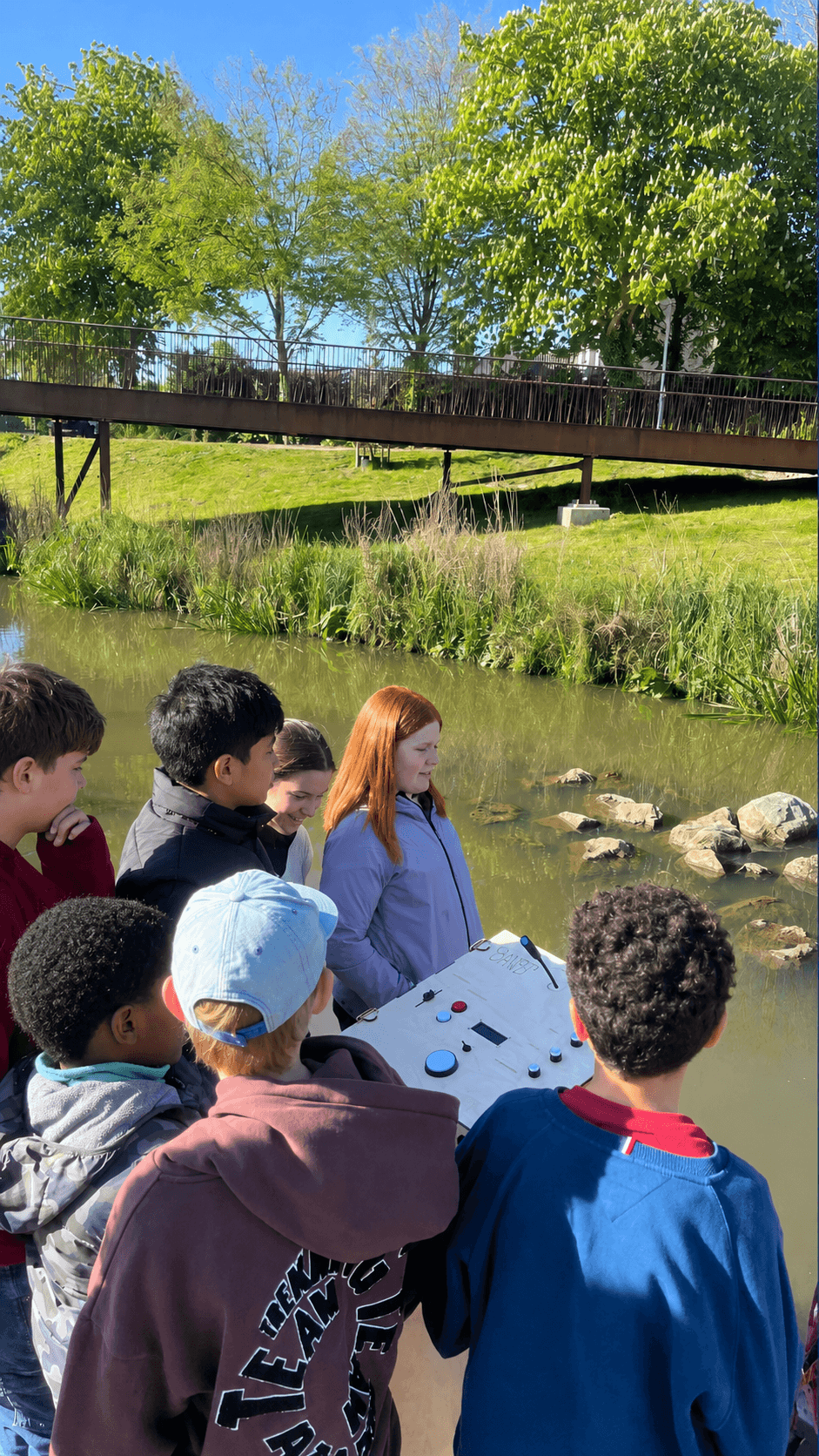
The Waterpraatpaal (water talking post) is a neat little console we built for the Waterwijs programme of the City of Bruges, together with Waterland vzw. Kids first investigate the water by measuring oxygen levels, nitrite, nitrate, Ph-levels, temperature, etc. They can enter this info in the console through buttons, knobs and sliders. Then the participants flick a switch so they can ask questions about what they found. They can literally ask the water how it feels and it’ll tell you, out loud, as itself.
Its voice is not scripted. The live readings for oxygen, nitrate and temperature go into the prompt with their exact values and units, and the AI turns them into a character with a mood: cheerful when the water is thriving, short of breath when the algae creep in, sad when there’s no water animals inside, fearful when it’s polluted etc. The water talks about its own condition. And the installation itself is modular, runs without cables, and travels to wherever the conversation is needed.
The Waterpraatpaal in action
Ask the water how it feels, and listen.
How sensor readings become the water’s voice
Move the sliders and watch the water react: real sensors do the same, the readings set its mood, color and voice.
“Hmm, I’m a bit off. The algae are creeping in and by night I get short of breath. A little less fertiliser would help.”
Target values for good status: oxygen > 6 mg/L, nitrate < 5.65 mg N/L (Flemish Environment Agency VMM and the EU Water Framework Directive).
Where the pollution comes from
Water does not get dirty on its own, and the creatures living in it give everything away.
Four sources shape the quality of the Reien: household discharges that skip the treatment plant, toilets and washing machines accidentally plumbed into the rainwater drain, nutrients flowing in from the Ghent Canal, and 27 storm overflows that relieve the sewers in heavy rain. Ask and the water names them, one by one.
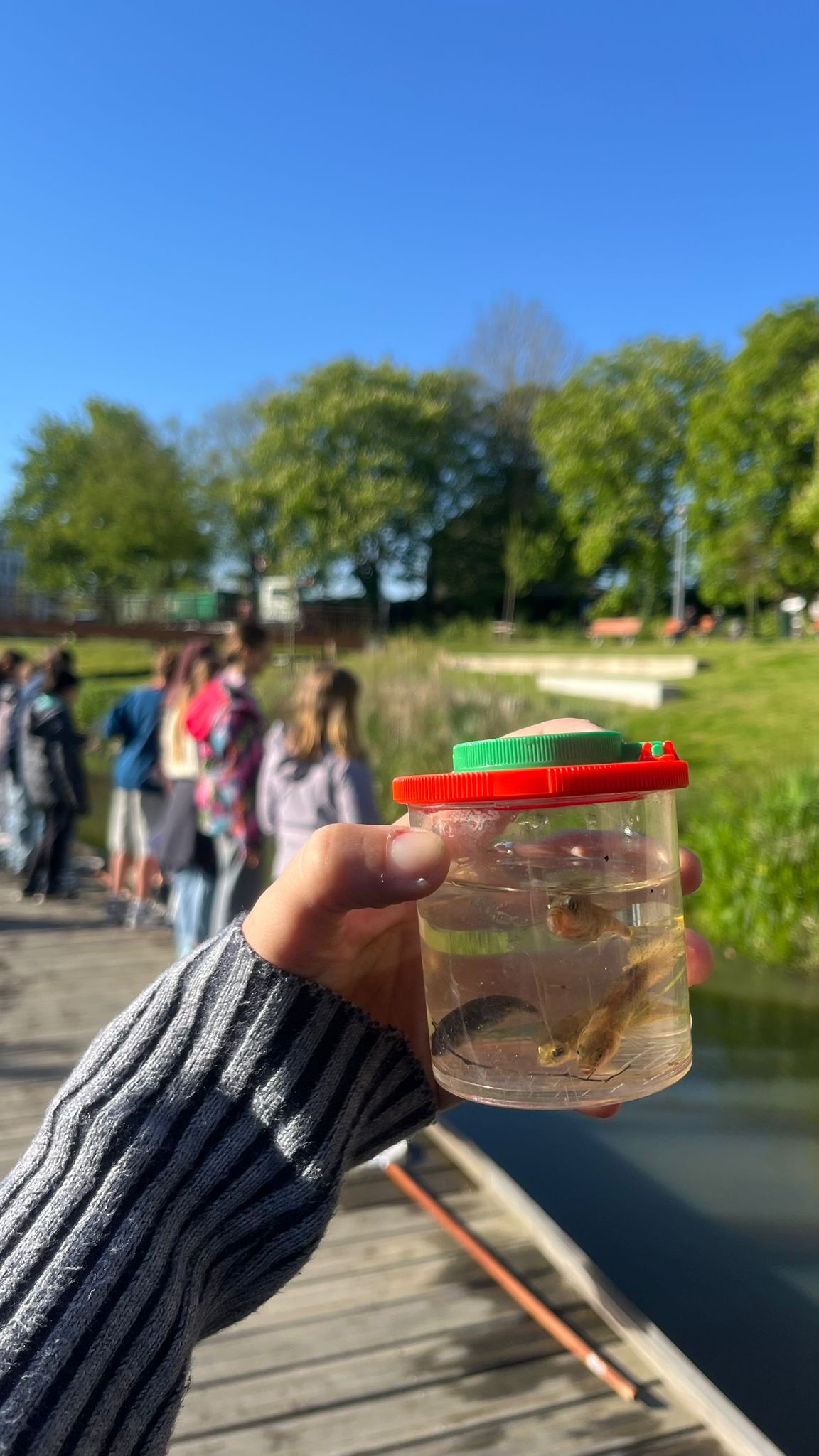
The best long-term reading is alive. Small water creatures tell you better than any single measurement how the water has been doing over time, and you do not even need to name them: the number of different species already says plenty.
- Clean, oxygen-rich water: stonefly and caddisfly larvae. Find these and the water is healthy.
- Reasonable water: mostly dragonfly larvae, snails and water mites. Heading the right way.
- Polluted water: only bloodworms, water slaters and leeches. Then the water is sick.
×
×
The living thermometer at work: catch, count, and then ask the water what it thinks.

How well do you know Bruges’ water?
Four questions, straight from the source material
1. How healthy are Bruges’ inner waters today?
2. Which water creature signals the cleanest water?
3. How many storm overflows does Bruges have?
4. What does too much nitrate do to the water?
A fixed part of the Waterwijs school workshops
The Waterpraatpaal is a fixed part of the Waterwijs school workshops, launched with a school class at the Langerei on 1 June 2026.
Part 1: The investigation
The children assess the water quality themselves, with test kits and by studying the water creatures they catch. In June 2026, entire classes did exactly that in two-day workshops, feet near the water.
Part 2: The panel talk
Then the class strikes up a conversation with the water as guest of honor, around statements the children pick themselves. The guest opens by introducing itself with a kind of CV.
Six statements to debate
- Water is as important as air for life.
- People may use the water, as long as they look after it.
- When people pollute the water, they hurt themselves.
- Water is not alive, but the plants and animals in it are.
- Water has rights too, just like people and animals.
- People influence how clean or dirty the water is.
What children ask
- “Can I swim with you?”
- “Does it hurt when litter falls on you?”
- “How many fish live here?”
- “When will all those bacteria and rubbish be gone?”
The kids are of course imaginative: otters and blobfish in the Reien, talking ducks, swimming like a fish. The AI hears it all.
“In some countries, like New Zealand, rivers already have the same rights as people! Then I’m no longer a ‘thing’ you use, but a neighbour you have to consider. What do you think: should I get a passport?”
That is how the water joins the debate on ‘Water has rights too’.
What cities and schools ask us first
Is the voice based on real data?
Yes. The readings come from sensors and lab measurements from Bruges, Ghent University and Kytos, topped up with citizen science from waarnemingen.be. The exact values, with their units, go into the prompt, so the mood always matches the water.
Can the installation travel?
Yes. It is wooden, modular and runs without cables, so it moves to events, schools and waterfronts wherever the conversation is needed.
Could our river talk?
Almost certainly. The Waterpraatpaal runs on the same engine that makes paintings talk. See how Talking Pictures works, or tell us about your water.
The same idea at other venues
The same idea in an art museum, a science centre and a war museum. Newest work first.
Want your water, your park or your painting to talk and respond?
Tell us where you would start. We will tell you honestly whether there is enough to say.
